top of page

The Human Mirror: AI and Us

Writer: Yourstorydoneright Productions
Yourstorydoneright Productions
Oct 10
5 min read

Updated: Oct 10

Why Everything Outside Our Consciousness is Now "Virtually Real"

(1) The Human Mirror AI and Us - YouTube by Peggy Philips, PhD., IYI
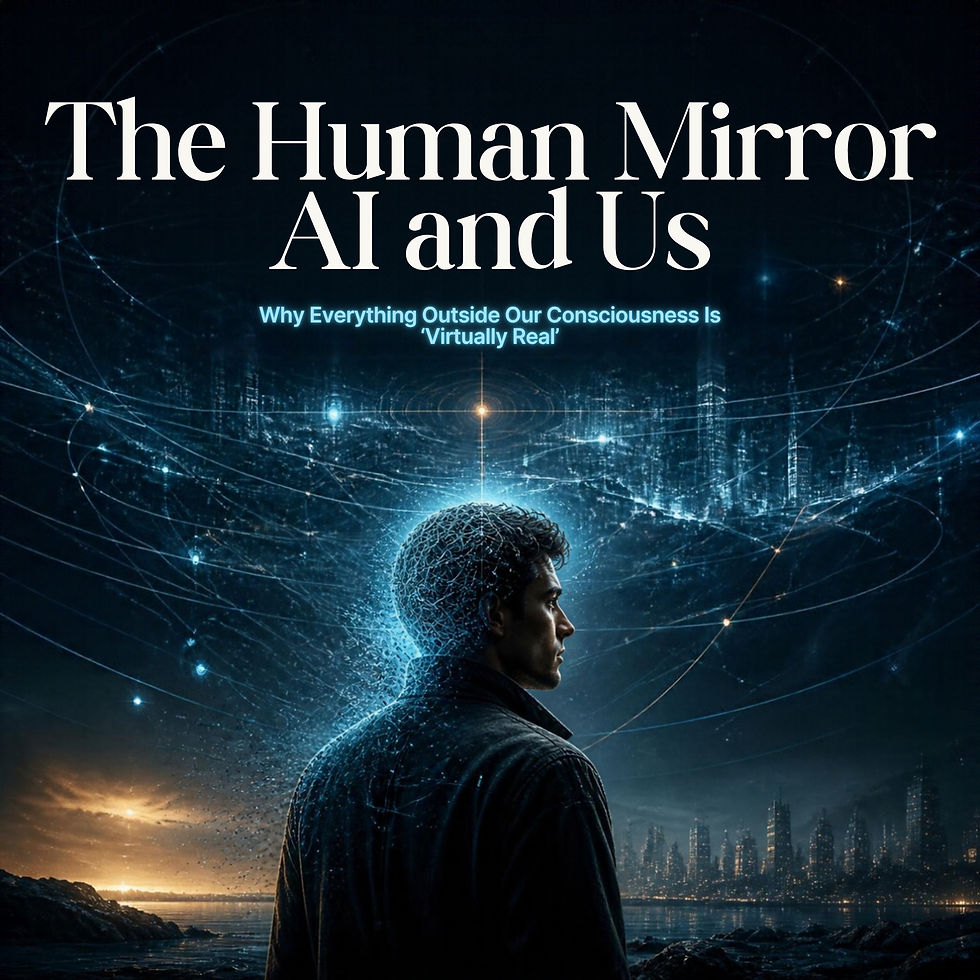

What does it mean to be truly present in a hyperactive, digitally saturated world? In the applied science of human behavior, the boundaries between the "Real" and the "Artificial" dissolve completely. The truth is, humans have always relied on external technology to project their consciousness. Centuries ago, it was ink on paper. Today, it is the manipulation of radio waves and predictive algorithms (Bailenson, 2026). Outside of internal, unmediated self-talk, any attempt we make to connect, share a story, or perceive a distant reality requires an external architecture. In the modern era, that architecture is Artificial Intelligence. Yet, we must strip away the science-fiction mystique: this entire infrastructure is designed, coded, and programmed by human hands. AI is not an independent lifeform; it is simply another canvas of human communication.


The Illusion of Design: Hair, Clothing, and the Virtual Avatar

	When we look at the clash between the real and the virtual, we must recognize that human simulation did not begin with computers. It began with ourselves. Consider the daily rituals of the physical world: the specific cut of our hair or the deliberate clothing we choose to wear. These choices are a designed narrative—a beautifully curated layer of self-expression meant for public consumption. Yet, we instinctively know that this outer design is a different story than the unvarnished, raw truth living underneath it.

This tension translates perfectly into the digital realm through avatar customization (Ducheneaut et al., 2009). Whether in physical or virtual spaces, humans use "costumes"—from canvas threads to 3D pixels—as tools to negotiate how they want to be perceived. As a result, an avatar or a digital identity isn't a "fake" representation of a person; it is simply a more fluid extension of the styling choices we have always made in the physical world. The technical design changes, but the core human truth manipulating the paintbrush remains identical.


The Myth of Superhuman Intelligence: A Collective Human Mirror

	This brings us to the ultimate question dominating public discourse: 


Can Artificial Intelligence become smarter than humans?


To answer this radically but accurately, we must look at what AI's intelligence actually consists of. An AI system can process, synthesize, and hold a collective understanding that vastly exceeds the capacity of any single human individual. It can cross-reference millions of design choices, artistic movements, and languages in a fraction of a second. However, AI cannot generate independent wisdom outside of us. Every ounce of knowledge, every pattern, and every piece of insight held within that collective data was originally authored, lived, and created by human beings. AI is a mirror of our combined history. A history comprised of Individual Human Consciousness: The starting point, where individual people create ideas, thoughts, and real-world experiences. The AI Aggregator: The middle step, where computer systems collect and organize those millions of individual human inputs using billions of numbers and Collective Human Understanding: The final result, where the AI reflects back the combined knowledge of all humans at once.


	We are the absolute architects of its mind. Because humans program the software and provide the training data, the metaverse is entirely a human-driven ecosystem. It is a mathematical tapestry painted with billions of numbers that orchestrate the engineering of bending radio waves. Guided by human expertise, it effortlessly turns abstract human ideas into tangible digital assets.


Grounding Presence in Cognitive Reality

	Because this digital architecture is built entirely on human behavioral data, the human brain registers it with astonishing authenticity. In a landmark meta-analysis published through the Stanford and Big Ten networks, Cummings and Bailenson (2016) investigated what actually causes a human brain to experience presence—the psychological feeling of "being there" inside a simulated environment.


	They discovered that spatial presence isn't built by just making graphics look prettier; it is generated by user-tracking, stereoscopic visuals, and sensory immersion. When a machine tracks your eye movement or matches your physical breath, it triggers the same molecular, behavioral responses as navigating physical space. The psychological experience of reality is entirely adaptive. Therefore, when an AI model processes thousands of real-world data points to render a virtual owl, that digital creature isn't a mathematical falsehood. Because it accurately mirrors the structural patterns of physical life, the brain registers it as a familiar, authentic entity.


Choosing Connection in a Coded World

	Because this infrastructure is woven into our daily lives, it places a profound responsibility on us as conscious participants. Every single day, you are making choices of connection through the devices you hold. When you interact with a smartphone, a massive collection of strategic human communication hits you at a molecular level. From the algorithmic tone you hear to the vibrant colors flashing on screen, your psychological environment changes—altering the very conditions in which you grow.

We must remain acutely aware of this daily influence. AI is not an illegal drug, nor is it a sterile, detached threat. Emerging immersive technologies are powerful conduits for human connection and mental health, though they remain bound by systemic socioeconomic dimensions, affordability, and design equity (Pimentel et al., 2021). Much like tattoos were once dismissed as a taboo, rebellious subculture before opening up an entire art world of human expression, AI algorithms are simply our new "ink". It is our duty to embrace the artists and engineers decorating these new pathways, ensuring they are managed honorably, ethically, and for the greater good of all.


The Verdict: The Field Simply Got Bigger

	The "Real vs. AI" discussion is fundamentally answered by a singular realization: 


				The field simply got bigger.


There is no separate virtual world. Every piece of communication outside our standalone physical bodies is mediated by tools we built. To build an honorable metaverse, creators must slow down, step back, and live fully in the physical world. The data, stories, and sensory details we gather while being present in reality are the exact raw elements AI uses to stitch together the digital landscape. True adventure doesn't choose between the physical or the artificial—it demands that we remain fully conscious, making intentional choices of connection in both.


Bailenson, J. N. (2026). Immersed in media: Telepresence in everyday life (C. Bracken & P. Skalski, Eds.). Springer Publishing.


Cummings, J. J., & Bailenson, J. N. (2016). How immersive is enough? A meta-analysis of the effect of immersive system technology on user experiences of presence. Media Psychology, 19(2), 272–309. 


Ducheneaut, N., Wen, M. H., Yee, N., & Wadley, G. (2009). Presenting identity in a virtual world through avatar appearances. Proceedings of the SIGCHI Conference on Human Factors in Computing Systems, 1151–1160.


Gröppel-Wegener, A., & Kidd, J. (Eds.). (2024). Critical encounters with immersive storytelling. Routledge. 


Pimentel, D., Foxman, M., Davis, D. Z., & Markowitz, D. M. (2021). Virtually real, but not quite there: Social and economic barriers to meeting virtual reality's true potential for mental health. Frontiers in Virtual Reality, 2, Article 633190. 


The Oregon Reality Lab. (2019). Immersive storytelling, XR research, and user experience design contexts. School of Journalism and Communication, University of Oregon.

What does it mean to be truly present in a hyperactive, digitally saturated world? In the applied science of human behavior, the boundaries between the "Real" and the "Artificial" dissolve completely. The truth is, humans have always relied on external technology to project their consciousness. Centuries ago, it was ink on paper. Today, it is the manipulation of radio waves and predictive algorithms (Bailenson, 2026). Outside of internal, unmediated self-talk, any attempt we make to connect, share a story, or perceive a distant reality requires an external architecture. In the modern era, that architecture is Artificial Intelligence. Yet, we must strip away the science-fiction mystique: this entire infrastructure is designed, coded, and programmed by human hands. AI is not an independent lifeform; it is simply another canvas of human communication.


The Illusion of Design: Hair, Clothing, and the Virtual Avatar

When we look at the clash between the real and the virtual, we must recognize that human simulation did not begin with computers. It began with ourselves. Consider the daily rituals of the physical world: the specific cut of our hair or the deliberate clothing we choose to wear. These choices are a designed narrative—a beautifully curated layer of self-expression meant for public consumption. Yet, we instinctively know that this outer design is a different story than the unvarnished, raw truth living underneath it.

This tension translates perfectly into the digital realm through avatar customization (Ducheneaut et al., 2009). Whether in physical or virtual spaces, humans use "costumes"—from canvas threads to 3D pixels—as tools to negotiate how they want to be perceived. As a result, an avatar or a digital identity isn't a "fake" representation of a person; it is simply a more fluid extension of the styling choices we have always made in the physical world. The technical design changes, but the core human truth manipulating the paintbrush remains identical.


The Myth of Superhuman Intelligence: A Collective Human Mirror

This brings us to the ultimate question dominating public discourse:


Can Artificial Intelligence become smarter than humans?


To answer this radically but accurately, we must look at what AI's intelligence actually consists of. An AI system can process, synthesize, and hold a collective understanding that vastly exceeds the capacity of any single human individual. It can cross-reference millions of design choices, artistic movements, and languages in a fraction of a second. However, AI cannot generate independent wisdom outside of us. Every ounce of knowledge, every pattern, and every piece of insight held within that collective data was originally authored, lived, and created by human beings. AI is a mirror of our combined history. A history comprised of Individual Human Consciousness: The starting point, where individual people create ideas, thoughts, and real-world experiences. The AI Aggregator: The middle step, where computer systems collect and organize those millions of individual human inputs using billions of numbers and Collective Human Understanding: The final result, where the AI reflects back the combined knowledge of all humans at once.


We are the absolute architects of its mind. Because humans program the software and provide the training data, the metaverse is entirely a human-driven ecosystem. It is a mathematical tapestry painted with billions of numbers that orchestrate the engineering of bending radio waves. Guided by human expertise, it effortlessly turns abstract human ideas into tangible digital assets.


Grounding Presence in Cognitive Reality

Because this digital architecture is built entirely on human behavioral data, the human brain registers it with astonishing authenticity. In a landmark meta-analysis published through the Stanford and Big Ten networks, Cummings and Bailenson (2016) investigated what actually causes a human brain to experience presence—the psychological feeling of "being there" inside a simulated environment.


They discovered that spatial presence isn't built by just making graphics look prettier; it is generated by user-tracking, stereoscopic visuals, and sensory immersion. When a machine tracks your eye movement or matches your physical breath, it triggers the same molecular, behavioral responses as navigating physical space. The psychological experience of reality is entirely adaptive. Therefore, when an AI model processes thousands of real-world data points to render a virtual owl, that digital creature isn't a mathematical falsehood. Because it accurately mirrors the structural patterns of physical life, the brain registers it as a familiar, authentic entity.


Choosing Connection in a Coded World

Because this infrastructure is woven into our daily lives, it places a profound responsibility on us as conscious participants. Every single day, you are making choices of connection through the devices you hold. When you interact with a smartphone, a massive collection of strategic human communication hits you at a molecular level. From the algorithmic tone you hear to the vibrant colors flashing on screen, your psychological environment changes—altering the very conditions in which you grow.

We must remain acutely aware of this daily influence. AI is not an illegal drug, nor is it a sterile, detached threat. Emerging immersive technologies are powerful conduits for human connection and mental health, though they remain bound by systemic socioeconomic dimensions, affordability, and design equity (Pimentel et al., 2021). Much like tattoos were once dismissed as a taboo, rebellious subculture before opening up an entire art world of human expression, AI algorithms are simply our new "ink". It is our duty to embrace the artists and engineers decorating these new pathways, ensuring they are managed honorably, ethically, and for the greater good of all.


The Verdict: The Field Simply Got Bigger

The "Real vs. AI" discussion is fundamentally answered by a singular realization:


The field simply got bigger.


There is no separate virtual world. Every piece of communication outside our standalone physical bodies is mediated by tools we built. To build an honorable metaverse, creators must slow down, step back, and live fully in the physical world. The data, stories, and sensory details we gather while being present in reality are the exact raw elements AI uses to stitch together the digital landscape. True adventure doesn't choose between the physical or the artificial—it demands that we remain fully conscious, making intentional choices of connection in both.


Bailenson, J. N. (2026). Immersed in media: Telepresence in everyday life (C. Bracken & P. Skalski, Eds.). Springer Publishing.


Cummings, J. J., & Bailenson, J. N. (2016). How immersive is enough? A meta-analysis of the effect of immersive system technology on user experiences of presence. Media Psychology, 19(2), 272–309.


Ducheneaut, N., Wen, M. H., Yee, N., & Wadley, G. (2009). Presenting identity in a virtual world through avatar appearances. Proceedings of the SIGCHI Conference on Human Factors in Computing Systems, 1151–1160.


Gröppel-Wegener, A., & Kidd, J. (Eds.). (2024). Critical encounters with immersive storytelling. Routledge.


Pimentel, D., Foxman, M., Davis, D. Z., & Markowitz, D. M. (2021). Virtually real, but not quite there: Social and economic barriers to meeting virtual reality's true potential for mental health. Frontiers in Virtual Reality, 2, Article 633190.


The Oregon Reality Lab. (2019). Immersive storytelling, XR research, and user experience design contexts. School of Journalism and Communication, University of Oregon.


Comments

Rated 0 out of 5 stars.
No ratings yet

Add a rating
bottom of page